
Tesla Lays Groundwork for Robotaxi Future at Wesley Chapel Service Center
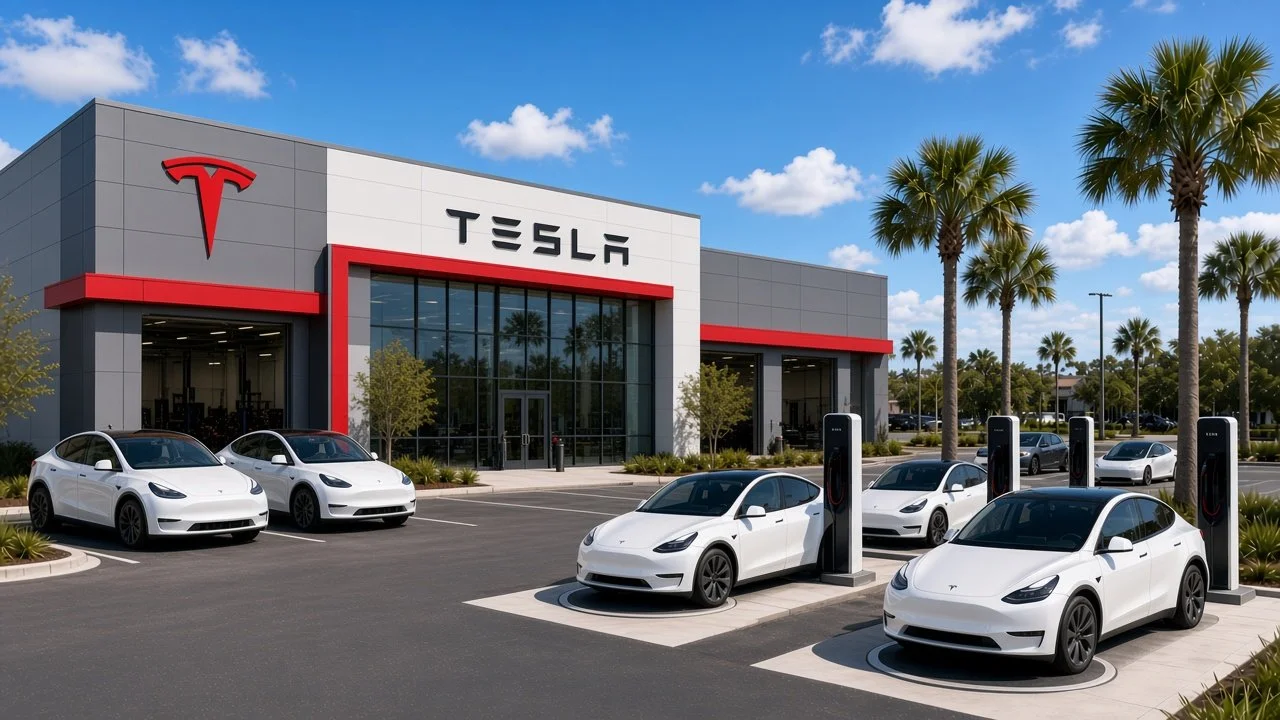
Tesla is currently in the planning and permitting stages to add dedicated robotaxi charging and docking infrastructures at its Wesley Chapel service center.
Tesla has filed permits for dedicated charging and docking infrastructure at its existing service center and store at 4980 Eagleston Boulevard in the Seven Oaks area. The plans, prepared by Dewberry Engineers Inc., are now moving through the official permitting process.
This is still early-stage planning and permitting. No construction timeline, completion date, or operational start has been announced. Tesla is simply putting the physical pieces in place that could one day support its autonomous robotaxi fleet in the region.
What does this mean? Wesley Chapel has grown rapidly into one of Pasco County’s premier destinations for families, businesses, and new development. Adding specialized robotaxi infrastructure at a major Tesla facility underscores that trajectory. It positions the community as a potential support hub for Tesla’s expanding autonomous network in the Tampa Bay area.
If the project advances, the site could help keep robotaxis charged, docked, and ready for service. That kind of dedicated setup is increasingly important as Tesla scales its driverless operations. For local residents, it signals that cutting-edge mobility options may eventually reach farther north from the current limited zones in Tampa. It also reinforces Wesley Chapel’s appeal as a place where innovation and everyday convenience are arriving together.
No service area or geofence for Wesley Chapel or broader Pasco County has been announced yet. Tesla’s existing robotaxi operations in Tampa remain confined to a relatively compact zone focused on downtown, Ybor City, Tampa Heights, West Tampa, and nearby neighborhoods. Those boundaries do not currently extend into the northern suburbs or Wesley Chapel.
The Eagleston Boulevard infrastructure is preparatory. It gives Tesla flexibility to support future expansion into the area once (and if) the company decides to enlarge its operational maps. Until then, the planning work itself is the news: the foundation is being laid locally.
Florida is home to roughly two dozen Tesla service centers, according to recent location data. At this time, the Wesley Chapel site appears to be the first in the state publicly advancing dedicated robotaxi charging and docking infrastructure through local permitting at an existing service center.
Tesla already operates unsupervised robotaxi service in Miami, Tampa, and Orlando. In those markets the company has relied on a mix of existing facilities, staging areas, and general Superchargers. Purpose-built or heavily specialized robotaxi hubs with private charging and maintenance have so far been more visible in other states such as Texas, Arizona, and Nevada. Wesley Chapel’s filing stands out as an early Florida example of adapting a consumer service center for potential fleet support.
Tesla’s robotaxi service is an on-demand, fully autonomous ride-hailing network. Riders use a dedicated app to request a vehicle that arrives without a human driver. Current operations primarily use Model Y vehicles running unsupervised Full Self-Driving software within mapped geofences. The purpose-built Cybercab—a two-seat vehicle with no steering wheel or pedals—is beginning to join the fleet in select markets.
The core goals are to deliver safer, more affordable transportation at scale; raise vehicle utilization far above the low rates of personally owned cars that sit idle most of the day; and create a new revenue stream for Tesla (and potentially for vehicle owners who participate in the network). Tesla has pointed to target operating costs around 20 cents per mile as a way to make rides significantly cheaper than traditional options while reducing the need for every household to own multiple cars.
